
Article Overview
Meteorological Convergence Zone: North Texas sits at the collision front of dry desert air, Canadian cold fronts, and moist Gulf airflow, creating severe atmospheric instability.
Evolution of Damage Scales: Ground-truth post-disaster forensic surveys transformed wind hazard analysis from the original 1971 Fujita scale to the wind-damage calibrated Enhanced Fujita Scale adopted in 2007.
Suburban Exposure Growth: Rapid residential expansion across the Dallas–Fort Worth metroplex continuously increases target density within historically active supercell corridors.
Structural Survival Limits: Standard residential wood-frame building codes resist basic wind shear but consistently fail under direct EF4 and EF5 rotational wind loads.
The Splintered Prairie: North Texas Under the Funnel
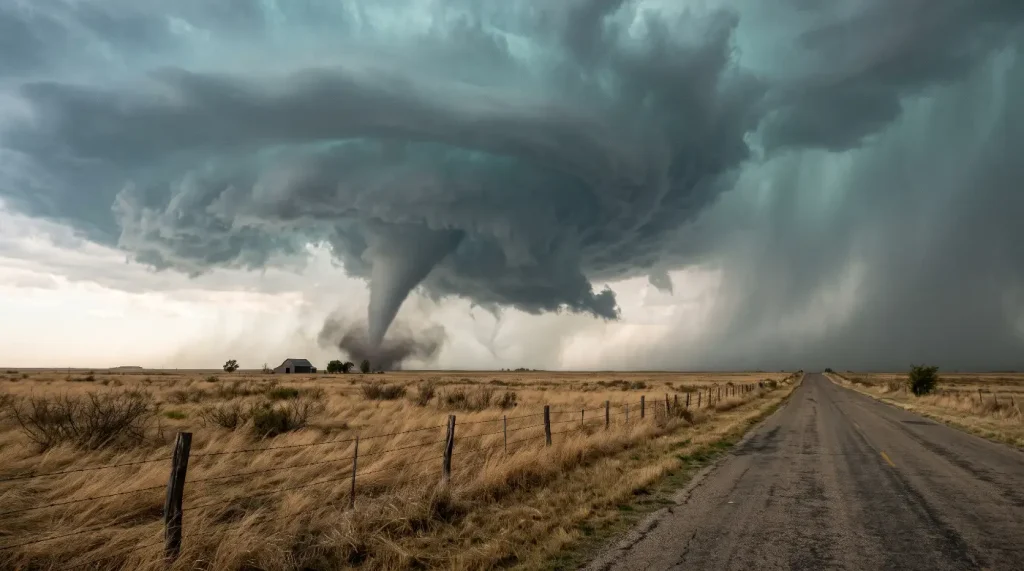
The brass barometric dial on the wall inside the Cooke County emergency dispatch office did not gently tick downward; it plunged with the speed of an anchor slipping into black water. Outside, the midday light lost its amber heat, replaced by a bruised, chlorotic green that longtime residents of the Red River Valley know intimately. Humidity clung to the skin like wet wool. In the open pastures north of Valley View, cattle ceased grazing and bunched tight against barbed-wire fence lines, backs turned to the darkening northern horizon. Radar screens at the regional National Weather Service forecast offices were already blooming with isolated, discrete supercell signatures—hook echoes sharp enough to suggest that the sky was curling in on itself.
A North Texas tornado is a violent convective atmospheric vortex characterized by a rapidly rotating column of air extending from a cumulonimbus cloud base to the earth’s surface. Within this geographical boundary, these cyclonic vortices manifest when moist maritime tropical air from the Gulf of Mexico undercuts hot, dry continental air from the Chihuahuan Desert along an atmospheric boundary known as the dryline. When an advancing mid-latitude cold front collides with this boundary, the resulting atmospheric instability generates vertical wind shear capable of sustaining catastrophic rotational velocities. Across two centuries of documented human settlement along the southern rim of Tornado Alley, these storms have repeatedly demonstrated that standard light-frame wood construction cannot withstand the dynamic pressures exerted by violent tornadic winds.
The Anatomy and Physical Record of North Texas Tornadic Events
North Texas tornadoes are severe cyclonic wind hazards generated by supercell thunderstorms that form along dryline boundaries and frontal intersections across the Red River basin and North Central Texas plains. The historical record reveals recurring clusters of violent, long-track events—most notably in Waco, Wichita Falls, and suburban Dallas–Fort Worth—that exert aerodynamic wind forces exceeding the structural capacity of typical wood-framed structures.
What atmospheric dynamics make North Texas uniquely prone to violent supercells?
The geographical alignment of the North Texas plains creates a natural atmospheric mixing bowl where three distinct air masses regularly collide to trigger severe convective storms.
Warm, moisture-laden air flows unimpeded northward from the Gulf of Mexico across the gentle upward slope of the Texas coastal plains. Simultaneously, elevated mixed layers of hot, arid air stream eastward off the high plateaus of northern Mexico and western Texas. This warm, dry desert air overrides the moist maritime boundary layer, forming a thermodynamic inversion known as a capping lid. This cap prevents premature thermal convection during early morning hours, allowing heat and moisture to pool and intensify beneath the boundary layer.
By late afternoon, surface heating destabilizes this inversion. Strong jet stream winds aloft provide intense vertical wind shear—meaning wind speed increases dramatically with altitude while shifting direction from southeasterly near the ground to southwesterly aloft. When surface parcels finally break through the capping inversion, they erupt into the upper troposphere at vertical speeds exceeding one hundred miles per hour. Consequently, the ambient horizontal rolling motion generated by the wind shear is tilted vertically into the storm’s updraft, forming a self-sustaining,rotating mesocyclone.
How did the catastrophic 1953 Waco and 1979 Wichita Falls storms reshape modern meteorological monitoring?
The catastrophic impacts of mid-century North Texas tornadoes exposed critical limitations in early warning networks and forced federal agencies to develop real-time Doppler radar surveillance.
On May 11, 1953, a massive multi-vortex tornado tore through downtown Waco, killing 114 people and destroying multi-story unreinforced brick masonry buildings that collapsed inward like dry cardboard. At that time, weather radar was primitive; meteorologists relied on visual spotters and coarse reflectivity scopes salvaged from surplus military aircraft. The catastrophic death toll in Waco made it undeniably clear that emergency managers needed continuous ground-truth networks and specialized storm-warning protocols.
Twenty-six years later, on April 10, 1979, the “Terrible Tuesday” tornado struck Wichita Falls, carving a path of destruction a mile wide through dense residential neighborhoods. Sixty percent of the serious injuries and fatalities occurred in vehicles, because hundreds of residents attempted to outrun the wedge-shaped vortex along congested suburban corridors. Atmospheric scientists studying the Wichita Falls event documented how the massive cyclonic vortex induced sudden microbarometric drops and generated boundary-layer projectile fields consisting of dimensional lumber, roofing materials, and pulverized brick.
The operational response to these recurring disasters drove the deployment of the nationwide WSR-88D NEXRAD Doppler radar network in the late 1980s and early 1990s. This network enabled meteorologists to identify tornadic vortex signatures long before a funnel touched the soil.
Early warning networks: Ground-based visual spotters, ham radio operators, and municipal civil defense sirens initially served as the primary operational defense against sudden convective ground strikes.
Doppler radar integration: The installation of high-resolution NEXRAD radar towers across the southern plains introduced velocity-tracking algorithms capable of detecting mid-level rotation inside convective clouds.
Dual-polarization upgrades: Contemporary radar networks transmit both horizontal and vertical radar wave pulses, allowing meteorologists to distinguish between raindrops, hail, and lofted structural debris fields in real time.
Why did structural engineers replace the original Fujita scale with the Enhanced Fujita Scale?
Structural engineers replaced the original damage estimation system because its empirical baseline relied on theoretical wind speeds that overestimated the force required to destroy light-frame buildings.
Dr. Tetsuya Theodore Fujita introduced his original rating methodology in 1971, categorizing storms from F0 to F5 based on outward physical damage. However, the system assumed that sweeping a typical suburban home clean from its foundation required horizontal wind velocities exceeding 260 miles per hour. Forensic investigations led by wind hazard researchers throughout the 1990s revealed that typical residential construction across North Texas consistently suffered structural detachment at substantially lower aerodynamic thresholds.
In 2007, structural engineers, wind researchers, and the National Weather Service formally adopted the Enhanced Fujita Scale. This refined assessment framework uses twenty-eight distinct Damage Indicators, ranging from single-family residences and strip malls to transmission towers and hardwood trees. Each indicator contains multiple degrees of damage that correlate observed material failures with calibrated three-second wind gusts.
Wind Damage Progression on Typical Light-Frame Residential Construction:

[EF0: 65-85 mph]  ──> Surface shingle loss, gutter peel, vinyl siding uplift
         │
[EF1: 86-110 mph] ──> Partial roof decking removed, exterior doors fail
         │
[EF2: 111-135 mph]──> Entire roof envelope detached, exterior walls stand
         │
[EF3: 136-165 mph]──> Upper-story walls buckle, exterior walls collapse
         │
[EF4: 166-200 mph]──> Complete structural leveling, anchor bolts fail in shear
         │
[EF5: >200 mph]   ──> Complete foundation wipeout, debris finely granulated
The Modern Suburban Corridor and Built-Environment Vulnerabilities
Modern residential building codes in North Texas require light-frame residential structures to withstand straight-line design wind speeds of 115 miles per hour, leaving modern suburban housing stock vulnerable to structural failure during direct hits from EF3, EF4, and EF5 tornadoes. As rapid municipal expansion converts open prairie pasture into densely packed housing tracts, the probability of severe tornadoes intercepting suburban population centers increases continuously.
How does rapid suburban development compound regional exposure across the Dallas–Fort Worth metroplex?
The rapid physical expansion of the Dallas–Fort Worth metropolitan area continuously converts historically empty agricultural pasture into continuous fields of composite shingles and wood-frame structures.
Throughout the nineteenth and early twentieth centuries, long-track violent tornadoes primarily tore across open prairie grasses, fence lines, and low-density livestock spreads. Today, that identical geography is covered by dense suburban tracts across Collin, Denton, Wise, and Tarrant counties. This continuous geographic infill creates an expansive target profile for convective hazards.
When a supercell produces a violent mesocyclone over North Texas today, the likelihood of that vortex encountering an unbroken grid of single-family homes, power lines, and commercial retail centers is higher than at any point in written history. This demographic clustering means that mid-strength tornadoes that once caused minor agricultural loss now produce severe economic and humanitarian emergencies.
What are the mechanical points of failure when tornadic winds strike light-frame homes?
Light-frame wood buildings fail under tornadic loads through a chain of pressure events that begins with roof envelope breaches and culminates in the collapse of exterior load-bearing walls.
The initial mechanical failure usually occurs at structural apertures: double garage doors, unreinforced patio doors, or broad picture windows. High-velocity aerodynamic drag pushes violently against these large surface areas. Once a garage door buckles inward under windward pressure, air rushes into the home, generating severe internal pressurization. Simultaneously, air rushing up and over the pitched roof structure creates high aerodynamic uplift suction along the eaves and ridge line.
This simultaneous internal outward push and external upward lift exceeds the capacity of standard toe-nailed wall-to-rafter connections. Once the roof decking and roof trusses pull free from the top plates of the walls, the exterior walls lose their lateral bracing. The unbraced wall studs then fold outward or collapse inward under the lateral forces, leading to progressive progressive pancake collapses.
Garage door deflection: Broad, non-reinforced garage doors buckle inward under extreme wind pressures,transforming an enclosed structure into an aerodynamically pressurized wind tunnel.
Roof sheath detachment: Standard roofing staples and smooth-shank framing nails pull directly out of rafter lumber under aerodynamic suction loads.
Sill plate shear failure: In homes fastened to concrete slab foundations using powder-actuated fasteners rather than cast-in-place steel anchor bolts, framing plates slide off foundation slabs under lateral shear forces.
Wind-borne projectile penetration: Flying debris punctures conventional residential exterior envelopes—such as brick veneer, cementitious siding, and drywall—injuring occupants sheltered in interior rooms.
Why do standard interior bathrooms and hallways fail to provide adequate life safety during violent tornadoes?
Standard interior hallways and ground-floor bathrooms fail to protect occupants during violent tornadoes because those spaces depend entirely on the survival of the surrounding architectural shell.
For decades, basic civil safety guidance instructed homeowners to shelter in an interior, windowless ground-floor bathroom under the assumption that surrounding plumbing walls and partition framing would provide structural shielding. However, forensic damage assessments of modern storms—such as the 2015 Garland–Rowlett tornado and the 2019 Dallas tornado—show that this guidance applies primarily to weaker EF0, EF1, and lower-end EF2 storms.
In high-end EF3, EF4, and EF5 events, dynamic wind forces sweep away exterior and interior partition walls alike.Bathroom drywall disintegrates, leaving plumbing pipes exposed and structural lumber splintered. Flying structural fragments, airborne roofing tiles, and shattered masonry enter the interior space at velocities exceeding one hundred miles per hour. Without an independently reinforced structural ceiling that can bear falling structural debris and deflect high-velocity impact projectiles, an interior room becomes a debris-collecting zone rather than a viable life-safety refuge.
Citations
National Institute of Standards and Technology (NIST): Technical Investigation of the May 22, 2011 Tornado in Joplin, Missouri (NIST NCSTAR 3). This comprehensive structural forensic investigation established baseline metrics for residential framing failure modes, building code evaluations, and wind-borne projectile dynamics during violent tornadic events.
Federal Emergency Management Agency (FEMA): FEMA P-361: Safe Rooms for Tornadoes and Hurricanes: Guidance for Community and Residential Safe Rooms (Fourth Edition). The benchmark engineering standard defining impact-resistance testing protocols, foundation anchoring requirements, and structural envelope resilience against 250-mph tornadic wind loads.
Operational Takeaways
Atmospheric Drivers: The intersection of dryline boundaries, low-level Gulf moisture, and strong vertical wind shear makes the North Texas prairie an active generator of long-lived, rotating supercells.
Engineering Realities: Standard residential construction codes are engineered for lateral straight-line winds up to 115 mph, whereas violent EF3 to EF5 tornadoes produce winds between 136 and over 200 mph.
Failure Sequence: Structural failure typically progresses from garage door deflection to roof envelope detachment, followed by wall collapse under lateral load.
Life Safety Needs: Standard interior rooms offer marginal survivability in direct violent hits; high-confidence life safety requires an engineered safe room structurally isolated from the building’s main frame.
Closing Resolution & Next Steps
Living along the North Texas prairie requires accepting the reality that atmospheric volatility is an enduring feature of the regional terrain. The collision of high plains winds and warm Gulf air will continue to generate supercells along the Red River valley, and suburban expansion will keep placing neighborhoods directly in their path. Relying on an interior hallway or bathroom under a standard pitched roof provides false security when a mesocyclone tracks across your street. Property owners, builders, and community planners across North Texas should audit their structural exposure,verify anchor-bolt installations on foundation slabs, and install engineered, impact-rated safe rooms built to withstand the extreme dynamic pressures of high-end tornadoes.
Engineered Protection Through Safe Rooms
Do not leave your family’s life safety to chance when tornadic rotation drops out of a North Texas sky. Visit Safe Rooms today to explore certified, above-ground and below-ground storm shelters engineered to meet and exceed FEMA P-361 and ICC 500 standards. Our custom-fabricated steel safe rooms are impact-tested to withstand 250-mph projectile strikes, anchoring directly to your concrete slab foundation to ensure that even if the house around you is torn away, your life-safety envelope remains intact. Protect your home and secure your peace of mind—schedule your professional site assessment with Safe Rooms now.