
Tornado Emergencies vs. Tornado Warnings: What Every Homeowner Needs to Know When Minutes Count
The difference between a Tornado Warning and a Tornado Emergency comes down to verification, ground truth, and catastrophic threat level. A Tornado Warning means that rotation has been detected on Doppler radar or a funnel has been spotted by storm spotters, requiring anyone in the designated danger area to seek interior shelter immediately. A Tornado Emergency is the National Weather Service’s highest, rarest alert tier: it is declared only when a catastrophic,violent tornado has been visually confirmed on the ground heading directly into a populated area, presenting an imminent risk of total structural destruction and mass casualties. During an emergency alert, everyday household interior rooms such as closets and hallways offer minimal protection, making engineered steel shelters built to withstand EF5 wind speeds essential for guaranteed survival.
When Sirens Sound: Understanding the Stakes Across Tornado Alley
If you live in Texas, Oklahoma, Kansas, Missouri, or anywhere across the heart of Tornado Alley, spring and summer afternoons can shift from quiet sunshine to bruised, rotating green skies within half an hour. Suddenly, the community sirens echo across the neighborhood. Your smartphone begins buzzing with the piercing, unmistakable tone of an emergency alert notification.
In that frantic, high-stress moment, clarity saves lives. Knowing the precise difference between the official warning levels issued by meteorologists tells you whether you have time to finish putting your shoes on, secure your pets, and grab emergency supplies, or whether you have only seconds to bolt a heavy steel door shut behind your family.
At Safe Rooms US, we have spent more than twenty-five years manufacturing and installing certified storm shelters for families, schools, and commercial facilities across severe weather country. To help you take decisive action when severe storms strike, let us explore the exact operational criteria used by meteorologists,the engineering realities of extreme wind forces, and how you can prepare your household before the next storm system develops.
The NWS Escalation Ladder: From Situational Awareness to Life-or-Death Shelter
Under National Weather Service Directive 10-511 (Warning Services), operational meteorologists follow strict,standardized criteria to communicate severe weather hazards. The alert hierarchy is designed like an escalating staircase that moves from broad situational awareness to hyper-localized, critical survival commands.
Tornado Watch: Atmospheric ingredients are favorable for severe storms capable of producing tornadoes across a large region. Homeowners should review emergency plans and remain alert.
Tornado Warning: A tornado is either actively occurring or imminent based on Doppler radar rotation or trained spotter reports. Move to designated shelter immediately.
Particularly Dangerous Situation (PDS) Tornado Warning: High atmospheric confidence indicates a long-track, intense, and destructive tornado capable of producing severe structural damage.
Tornado Emergency: A catastrophic, confirmed tornado is on the ground actively moving into a populated community. Immediate shelter inside a FEMA-rated storm room or reinforced underground bunker is required to survive.
1. Tornado Watch: Atmospheric Ingredients Are Ready
Think of a Tornado Watch like having all the necessary ingredients to bake a cake sitting on your kitchen counter: the flour, eggs, sugar, baking powder, and milk are all present. You have not mixed the batter or placed the pan in the oven,but the elements are gathered in one place.
A watch typically covers dozens of counties, spans multiple states, and remains active for a window of four to eight hours. During a watch:
Ambient wind shear, surface heating, low-level moisture, and atmospheric instability have aligned to favor supercell thunderstorms.
You do not need to interrupt your daily routine to crawl inside your safe room.
You should charge mobile devices, monitor NOAA weather radio broadcasts, check that your flashlight batteries work, locate pet carriers, and make sure your shelter entrance is completely free of clutter.
2. Tornado Warning: Immediate Danger in Your Vicinity
Returning to the baking analogy: the cake is now actively baking in the oven. A funnel has either formed or is rapidly organizing above the ground.
The National Weather Service issues a localized Tornado Warning under two distinct observational triggers:
Radar-Indicated Rotation: Dual-polarization Doppler radar detects tight, circulating wind patterns inside a storm’s mesocyclone, indicating tornadogenesis is underway.
Observed and Spotted: Trained Skywarn spotters, law enforcement personnel, emergency managers, or certified broadcast meteorologists report a condensation funnel or rotating debris cloud making ground contact.
Peace of Mind Takeaway: A Tornado Warning covers a targeted geographic polygon and typically gives residents between eight and thirteen minutes of average lead time. When your community enters that warning polygon, seek your reinforced shelter without hesitation.
3. PDS (Particularly Dangerous Situation) Warning: Enhanced Threat of Violence
Over time, meteorologists recognized that frequent low-end warnings can lead to alert fatigue among the public. To signal storms with an unusually violent character, the NWS introduced the Particularly Dangerous Situation wording tag.
When forecasters identify supercells tracking through exceptionally volatile atmospheres, pointing toward large wedge tornadoes capable of EF3, EF4, or EF5 destruction, they embed PDS language into the warning text. Hearing a broadcast meteorologist announce a Particularly Dangerous Situation means that ordinary residential walls and standard stick-built construction face extreme risks of catastrophic failure.
4. Tornado Emergency: The Rarest, Most Urgent Alert Tier
First coined on May 3, 1999, during the historic F5 Bridge Creek-Moore tornado in central Oklahoma, the Tornado Emergency alert represents the highest level of weather alarm in existence.
To issue a Tornado Emergency under NWS Directive 10-511, specific conditions must be verified simultaneously:
Severe, Confirmed Tornado on the Ground: The tornado must be verified either by reliable ground spotters or by a clear Tornado Debris Signature on radar, which shows building insulation, wood, metal, and trees being lofted thousands of feet into the sky.
Direct Path Into a Populated Area: The path of the rotating vortex is aimed directly at an incorporated town,residential subdivision, school district, or urban center.
Expectation of Catastrophic Damage and Loss of Life: The wind speeds and debris field are intense enough that ordinary interior residential rooms cannot ensure human survival.
During a declared Tornado Emergency, standard recommendations to huddle in a central hallway, hallway closet, or bathtub under a mattress are largely inadequate against extreme debris and total structural collapse.
Detailed Alert Tier Comparison
Tornado Watch Profile
Frequency: Frequent throughout spring, summer, and late autumn severe weather setups.
Trigger Criteria: Favorable convective atmospheric conditions, frontal boundaries, and significant wind shear across a broad region.
Threat to Residential Structures: No direct threat at the moment of issuance; potential for storm development later in the day.
Action Required: Keep weather radios on, locate family members, confirm safe room keys and combinations,and charge communication devices.
Tornado Warning Profile
Frequency: Common across local counties during active severe thunderstorm lines and supercell events.
Trigger Criteria: Doppler radar detecting tight velocity rotation or a spotter sighting a developing funnel cloud.
Threat to Residential Structures: Moderate to high danger, with frequent occurrences of EF0 to EF2 wind speeds capable of stripping roofs, downing chimneys, and shattering windows.
Action Required: Move all household members and pets into your interior safe room or reinforced shelter immediately.
Particularly Dangerous Situation (PDS) Warning Profile
Frequency: Infrequent; reserved for high-end multi-vortex or violent supercell environments.
Trigger Criteria: High meteorological confidence in an intense, long-track tornado moving along an established storm corridor.
Threat to Residential Structures: Severe structural danger, including EF3 or greater wind forces capable of flattening outer walls and ripping away second stories.
Action Required: Enter your steel safe room immediately, put on protective headgear, and remain secured until the storm cell tracks past your location.
Tornado Emergency Profile
Frequency: Extremely rare; issued only a handful of times per year across the entire country.
Trigger Criteria: Visual confirmation or radar debris confirmation of a violent, destructive tornado heading directly into a populated area.
Threat to Residential Structures: Catastrophic threat level, including EF4 to EF5 wind forces capable of leveling well-constructed homes down to the foundation slab.
Action Required: Immediate shelter inside a FEMA-certified above-ground safe room or below-ground reinforced bunker is necessary to survive.
The Physics of an EF5 Tornado: Why Standard Rooms Fail
To understand why ordinary home construction fails in a Tornado Emergency, one must examine the physical forces generated by an Enhanced Fujita Scale Category 5 event. An EF5 tornado produces winds in excess of 200 mph, often reaching speeds between 250 and 318 mph.
Standard modern homes are built using wooden two-by-four wall studs, exterior plywood or oriented strand board,drywall, and asphalt shingles, held together by framing nails and thin steel Hurricane ties. When winds exceed 200 mph, four destructive stages occur in rapid succession:
Aerodynamic Roof Uplift: High-velocity winds moving over a gabled or hip roof create immense negative pressure, behaving identically to an airplane wing. This pressure lifts the roof trusses directly off the framing plates.
Wall Failure and Outward Blowout: Once the roof structure is ripped away, the exterior walls lose their overhead horizontal bracing. The sheer force of the wind pushes windward walls inward and sucks leeward walls outward.
Internal Pressurization: When a window, sliding glass door, or garage door fails under wind pressure, air rushes into the home at extreme velocity. This internal pressure acts like an expanding balloon, blowing ceilings and interior partition walls apart from within.
Windborne Projectiles: The primary cause of casualties during severe tornadoes is flying debris. At 200 to 250 mph, loose debris transforms into high-velocity projectiles. Construction lumber, tree branches, roof shingles,and metal siding travel with enough kinetic force to pierce brick veneers, sheetrock, and wooden doors.
Engineering Survival: The Safe Rooms US Advantage
At Safe Rooms US, our manufacturing and installation standards are developed around worst-case storm dynamics. We construct our residential and commercial units to meet and exceed the strict design parameters outlined in FEMA P-320 (Taking Shelter from the Storm) and FEMA P-361 (Design and Construction Guidance for Community Safe Rooms).
The Texas Tech Impact Test: 100 mph Missile Defense
To prove that our shelter panels can turn away deadly flying debris, our designs undergo rigorous testing at the National Wind Institute at Texas Tech University.
During the testing procedure, an air cannon fires a 15-pound wooden two-by-four stud at 100 mph directly at the face of our steel panels, welded joints, and multi-lock door assemblies. A 15-pound lumber projectile traveling at 100 mph matches the impact energy generated by debris carried inside a 250 mph EF5 tornado. While this test missile easily shatters through double brick walls, stone facades, and reinforced concrete cinder blocks, it cannot penetrate our solid steel walls.
Solid Steel Foundation Anchoring: Steel Taproots
Homeowners often wonder whether an above-ground safe room can be tipped over or blown away if the house around it is swept clean down to the slab.
The secret lies in our foundation anchoring methodology. We use industrial-grade concrete wedge anchor bolts embedded directly into your existing reinforced garage concrete floor or patio foundation slab.
Think of these anchor bolts as an array of deep, unbreakable steel taproots. Each mechanical anchor is torqued to specific engineering tolerances, providing thousands of pounds of upward pullout resistance and lateral shear strength.Fastened along the solid steel perimeter floor channels, these anchors fuse the safe room to the enormous weight of your concrete slab foundation. The surrounding house framing may be swept away, but the anchored steel room stays fixed in place.
Precision-Engineered Doors and Entrances
A storm shelter must be simple to enter under intense duress and reliable to exit after the weather clears:
36-Inch Wheelchair-Accessible Clearance: We fabricate our units with wide, 36-inch entrances featuring low-profile, beveled thresholds. This design allows family members using wheelchairs, motorized mobility scooters,walkers, or baby strollers to roll directly inside without catching on floor tracks.
Multi-Point Locking Mechanism: Our doors utilize three or four heavy steel sliding deadbolts that lock deeply into the reinforced steel frame at multiple elevations, preventing wind suction from warping or peeling the door leaf.
Removable Emergency Pin Hinges: If building debris, fallen rafters, or a displaced vehicle blocks the safe room door from opening outward after the tornado passes, our heavy-duty barrel hinges feature removable pins that allow the door to be unbolted or unpinned from the inside.
Review detailed structural specifications and certifications on our shelter engineering and sizing page to compare available configurations.
Where to Place Your Above-Ground Safe Room
Gone are the days when taking shelter required running outside into dark, cold rain to climb down a steep ladder into a flooded, damp cellar. Above-ground shelters provide rapid, level access directly within your home’s footprint.
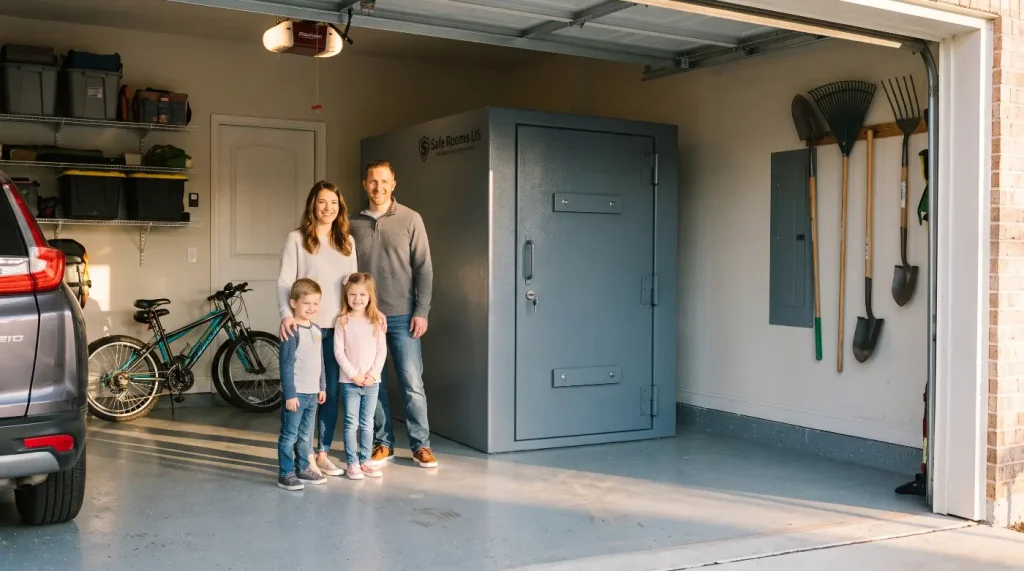
Inside the Garage: The garage floor slab is typically the most straightforward and cost-effective installation site.It keeps the safe room sheltered from routine weathering, leaves plenty of room for parked vehicles, and provides immediate, step-free access from the kitchen or mudroom.
Master Closet or Pantry: During home construction or major interior remodeling, safe rooms can be framed cleanly into master walk-in closets or walk-in pantries. When severe weather hits in the middle of the night, your family can step directly from the bedroom into a fortified shelter within seconds.
Outdoor Reinforced Patio Slabs: If your home is built on a pier-and-beam crawlspace or lacks adequate garage floor clearance, our weather-sealed exterior units can be anchored directly to an outdoor structural concrete patio pad adjacent to your back door.
Recommended Sizing by Household Size
FEMA guidelines recommend planning for three to five square feet of floor space per person during a tornado event.However, families often prefer extra room to accommodate fold-down seating, emergency supplies, and pet kennels.
4 Feet by 4 Feet: Accommodates 3 to 4 individuals. Excellent for couples or small families with limited garage space.
4 Feet by 6 Feet: Accommodates 5 to 7 individuals. The most popular choice for typical four-person households, allowing ample room for pets, storage bins, and folding chairs.
6 Feet by 6 Feet: Accommodates 8 to 10 individuals. Ideal for extended multi-generational families or homeowners who want space for wheelchairs, cots, and long-term storage.
Custom Commercial Footprints: Sized for 20 to 100+ occupants. Engineered for corporate headquarters,manufacturing warehouses, rural fire stations, daycare centers, and places of worship.
Discover how property owners throughout Texas and Oklahoma trust their storm plans to our systems by reading through our homeowner reviews and case studies.
Safe Room Staging Checklist: Prepare Before the Sirens Wail
A storm shelter is only as functional as the supplies you keep stocked inside. Do not wait until a Tornado Emergency alert sounds to search for essentials. Keep the following items inside your room all season long:
Protective Helmets: Construction hardhats, bicycle helmets, or motorcycle helmets provide critical head protection against falling objects if you open the door post-storm.
Heavy Leather Work Gloves and Work Boots: Keep sturdy boots inside the room so you can safely walk over shattered glass, exposed nails, and splintered lumber after exiting.
NOAA Weather Radio and Extra Batteries: Maintain an independent, battery-powered receiver to track warnings when power lines and local cellular towers go down.
High-Lumen Flashlights and Glow Sticks: Safe, battery-operated lighting that produces no open flame or fire hazard if gas lines rupture nearby.
Loud Whistle or Marine Air Horn: A simple whistle allows you to alert emergency search crews to your position without straining your voice or inhaling airborne dust.
Prescription Medications and First Aid Kit: Maintain a seven-day backup supply of critical prescriptions,along with antiseptic wipes, pressure bandages, and splints.
Comfort Items for Pets and Children: Collapsible water bowls, slip leashes, pet treats, noise-canceling headphones for thunder, and small games to keep children calm.
Frequently Asked Questions
Will an above-ground safe room truly survive a direct strike from an EF5 tornado?
Yes. Our shelters are manufactured from heavy structural steel and laboratory tested at Texas Tech University to withstand 250 mph winds and 100 mph airborne missile strikes, meeting all FEMA P-320 and FEMA P-361 standards.When anchored into a properly engineered concrete slab, an above-ground safe room provides the exact same life-saving structural integrity as an underground bunker without the risks of stairway falls, ground water seepage, or debris trapping you beneath a hatch.
Can elderly family members or individuals using wheelchairs enter the shelter easily?
Yes. Our shelters feature full 36-inch-wide doorways with flush, low-profile floor thresholds designed to comply with accessibility standards. This wide, flat entrance makes it easy for individuals with wheelchairs, mobility walkers, canes,or baby strollers to roll directly inside without catching on raised lip seals or negotiating hazardous underground ladders.
What happens if collapsed building debris falls against the door during the storm?
Our safe room doors are built with interior multi-point sliding latches and heavy-duty structural barrel hinges that feature removable hinge pins. If falling building framing, garage doors, or a shifted vehicle blocks the door from swinging outward after the storm passes, the occupants can unpin the hinges from the inside, or first responders can easily attach recovery cables to the external anchor points.
How long does the installation process take on an existing garage floor?
A standard residential installation on an existing, sound concrete garage slab is typically completed in two to four hours. Our certified in-house installation team manages drilling, debris extraction, wedge anchor setting, torque verification, and final cleanup, meaning your shelter is fully operational the day it is installed.
Can I relocate my safe room if my family moves to a new home?
Yes. Because our units are mechanically bolted to the concrete slab using heavy-duty wedge anchors rather than permanently cast into concrete, our technicians can unbolt the unit, repair the concrete holes cleanly, transport the shelter to your new property, and securely re-anchor it on your new garage floor.
Protect What Matters Most: Talk with Safe Rooms US Today
Living in Tornado Alley means accepting that violent supercell storms are a seasonal reality. However, enduring a severe weather outbreak does not have to mean waiting in fear inside a flimsy bathroom or cramped interior closet.
When your home is equipped with a certified, solid steel safe room anchored into your foundation, the wail of a tornado siren becomes a clear call to action rather than a moment of panic. You know your family, your pets, and your most valuable emergency supplies are safe behind heavy-gauge American steel engineered to handle the strongest winds on Earth.
Take control of your household storm safety before the next outbreak targets your neighborhood. Contact the experienced team at Safe Rooms US today to discuss dimensions, explore garage layout options, and request your free custom safe room quote. Let our twenty-five years of shelter experience give your family permanent peace of mind.