Storm Shelter Resources

Welcome to the Safe Rooms blog, your trusted resource for severe weather protection, storm shelter technology, and home defense solutions. From navigating FEMA guidelines and comparing above-ground vs. underground storm shelters to expert tips on emergency preparedness, our articles provide the actionable insights you need to protect what matters most. Whether you are planning a custom safe room installation or preparing your family for tornado season, explore our latest guides to build lasting security and peace of mind.

safe room
Blog

Safe Rooms: Mobility, Access, and Survival

Executive Review Steep Stairway Barriers: Subterranean shelters feature steep stairways, narrow drop hatches, and awkward angled doors that create impassable physical barriers for individuals using mobility devices. Level Zero-Threshold Ingress: Above-ground storm shelters engineered to ICC 500 and FEMA P-361 standards provide zero-step thresholds, expansive clear door openings, and unobstructed floor space for immediate entry during emergencies. Seconds Dictate Survival: Severe tornado lead times average between eight and twelve minutes, making rapid,independent wheel-in access essential


Read More »
flying debris 2x4
Blog

The Physics of Flying Debris: Why 2×4 Lumber Pierces Brick

Article Preview Kinetic Concentration Over Material Hardness: A 15-pound piece of structural lumber traveling at 100 miles per hour delivers over 5,000 foot-pounds of energy across an impact footprint measuring only 5.25 square inches. Brittle Shear Failure in Masonry: Residential clay brick veneers and unreinforced concrete masonry units exhibit high compressive strength but nominal shear and tensile resistance, causing brittle punching shear rather than missile deformation. Standard Code Inadequacies: Conventional residential building envelopes are engineered

Read More »
Construction blueprint with a drill and screws on a wooden table.
Blog

What To Look for in a Storm Safe Room? A Dallas Homeowner’s Guide

Shopping for a shelter can feel like comparing products that all promise the same thing. Knowing what to look for in a safe room turns that into a short checklist, and most of it comes down to features you can see, measure or ask about. Here is how to tell a purpose-built shelter from a closet that merely feels sturdy. Why an Ordinary Room Falls Short A hallway closet may feel protected, but FEMA’s advisory on

Read More »
north texas tornado funnel
Blog

The Splintered Prairie: North Texas Under the Funnel

Article Overview Meteorological Convergence Zone: North Texas sits at the collision front of dry desert air, Canadian cold fronts, and moist Gulf airflow, creating severe atmospheric instability. Evolution of Damage Scales: Ground-truth post-disaster forensic surveys transformed wind hazard analysis from the original 1971 Fujita scale to the wind-damage calibrated Enhanced Fujita Scale adopted in 2007. Suburban Exposure Growth: Rapid residential expansion across the Dallas–Fort Worth metroplex continuously increases target density within historically active supercell corridors.

Read More »
tornado warning
Blog

Tornado Emergency vs. Warning: The Critical Difference

Article Overview Operational Escalation: A Tornado Warning indicates a tornado is detected or imminent, whereas a Tornado Emergency indicates a confirmed, violent tornado is actively causing catastrophic damage in a populated area. Strict Issuance Criteria: Under National Weather Service Directive 10-511, forecasters cannot issue a Tornado Emergency without confirmed human hazard, severe structural destruction, and reliable spotter or radar confirmation. Behavioral Mandate: Standard home sheltering may suffice for common warnings, but a Tornado Emergency requires

Read More »
Blog

Above Ground Safe Rooms: Safety Made Simple – Infograph

This infographic highlights how above-ground safe rooms provide accessible protection during severe weather events. It explains key features such as FEMA-compliant reinforced steel construction, impact-tested designs, secure entry systems, and practical installation benefits. The content helps homeowners understand how safe rooms can provide reliable storm protection while fitting into everyday living spaces.

Read More »
texas tech
Safe Rooms

Inside the Cannon: How Texas Tech Defeats 250 MPH Debris

Executive Synthesis Empirical Missile Calibration: The Texas Tech National Wind Institute replicates 250 mile-per-hour tornado wind fields by launching a 15-pound, nominal 2×4 lumber projectile at 100 miles per hour using a specialized compressed-air pneumatic cannon. Structural Failure Mechanics: Standard residential construction—including traditional brick veneer, concrete masonry units, and unreinforced drywall—ruptures instantly because hollow, brittle, or weakly fastened materials cannot absorb focused, high-speed dynamic shear loads. Composite Dissipation Thresholds: Certified shelter wall assemblies survive through

Read More »
safe room fema
Safe Rooms

FEMA P-320 vs. FEMA P-361: Safe Room Engineering

Article Overview Structural Intent Divergence: FEMA P-320 governs residential safe rooms sheltering up to sixteen occupants,whereas FEMA P-361 dictates criteria for commercial, civic, and community refuges hosting hundreds under strict institutional oversight. Continuous Load Path Integrity: Both manuals require resistance against 250-mile-per-hour tornado winds,but FEMA P-361 mandates rigorous peer-reviewed structural engineering calculations, internal pressurization analysis, and continuous load path transfers directly to the foundation. Mechanical Life Support Baselines: FEMA P-361 enforces dedicated emergency ventilation, sanitation

Read More »
storm shelter prep
Blog

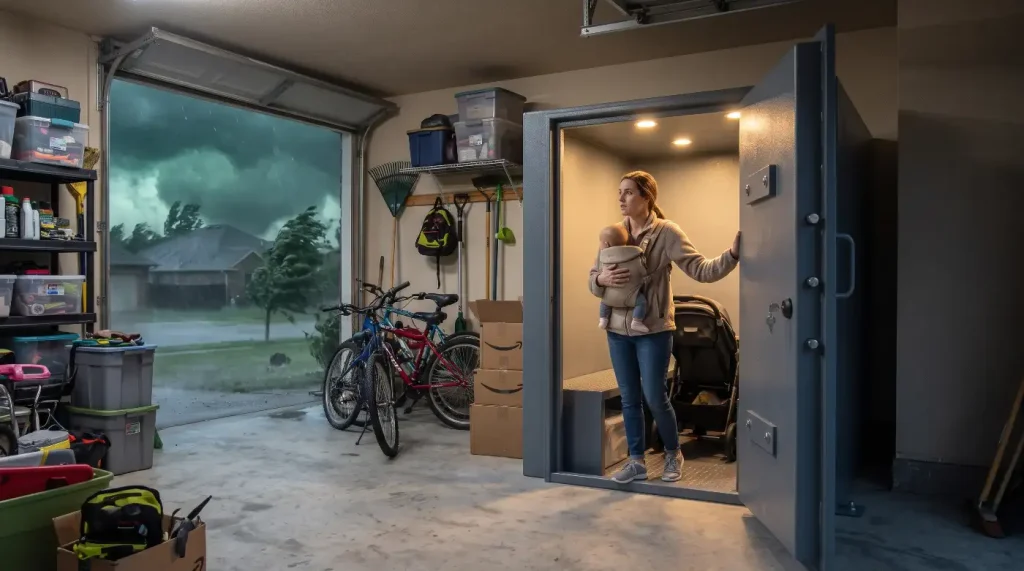
Baby & Toddler Storm Shelter Prep: Zero-Notice Guide

Fast Track Summary Pack ahead for zero-notice alerts: Keep an airtight grab-and-go kit inside your shelter with ready-to-feed formula, diapers, toddler hearing protection, and a lightweight infant carrier. Prioritize immediate walk-in access: Navigating steep, slippery underground shelter stairs while holding a crying infant at 2:00 AM creates severe fall hazards; ground-level steel rooms eliminate entry delays. Insulate against loud barometric noise: Children panic from roaring winds, pressure shifts, and blaring sirens; noise-canceling earmuffs and familiar

Read More »